The token is the moment most plot deals are really decided. Someone shows you a neat layout with fresh boundary stones and a board at the gate, the plot you like is "one of the last good ones", and you're asked for a token to hold it. Once that money's paid, walking away gets harder, emotionally and sometimes legally.
We'd like you to do your checks before the token, not after. None of what follows needs a lawyer to start with. Most of it is public, and a lot of it is online. You'll still want a lawyer before the sale deed, and we'll say where, but you can rule out a bad layout on your own in a couple of evenings.
A word on scope. This is general information about Maharashtra, written for buyers around Ahilyanagar, including the layouts coming up near Supa MIDC on the Pune road. Rules change, and some changed recently. Where we couldn't confirm a rule from an official source we've said so, and in those places you should ask your lawyer.
Start with the 7/12 and the 8A
The 7/12 extract, or satbara, is the record of rights for a piece of land. It shows the survey or gat number and the area. It also shows the names of the holders, and other rights or charges on the land, such as a bank loan. The 8A shows all the land a holder has in the village. Download both before your second visit.
The digitally signed 7/12 has been online since 18 September 2019, according to the land records department's FAQ, and there's a free copy to read on Mahabhulekh as well. We've written a step-by-step guide to downloading it, and our 7/12 checklist goes through it column by column.
On a layout, look for a few things. Does the name on the 7/12 match the person selling, or does the developer hold a registered power of attorney from that person? Does the record show the land as non-agricultural, or does it still read like a farm? Is there anything in the "other rights" column, like a loan or a tenant's name, that nobody mentioned?
Also ask what record your own plot will have after the sale. On some layouts each plot ends up with its own entry. On others, buyers share one survey number for years. Ask your lawyer what that would mean for you when you sell or take a loan.
Read the ferfar, not only the latest entry
Every change on a 7/12 happens through a ferfar, a mutation entry with its own number and date. Sales and inheritances show up as ferfars. Loans appear there too, and a conversion to NA gets its own entry. The 7/12 tells you who holds the land today, while the ferfars tell you how they came to hold it.
Older entries are scanned and available on the state's e-records site. Pull the ferfars that changed the holder, and the one that recorded the NA permission, and read them in order. You're looking for gaps. If the land passed from a father to one son with no mention of the other children, or the seller's name appears without any entry explaining how, that's a question for the seller first and your lawyer second.
Also check for a pending ferfar. The land records department has a page showing the status of mutation entries that haven't been certified yet. A pending entry can mean someone else's sale or a dispute is already in progress on the same land.
The NA permission, and why the rules changed
Agricultural land can't simply be cut into house plots. Its use has to be permitted as non-agricultural, which everyone calls NA. For years that meant a separate NA order from the Collector's office under the Maharashtra Land Revenue Code, and the order and its conditions were noted on the 7/12.
That process changed recently. The Land Revenue Code was amended in 2025, and a Revenue Department order of February 2026 is reported to say that a separate NA permission isn't needed where the planning authority grants development permission for land that's allowed for that use. We've read the amending Bill but couldn't confirm every detail of the final rules, so we won't tell you exactly which papers a new layout should have. Ask your lawyer which system your layout came under.
In practice, ask for the NA order itself if the layout is older, with its date and its conditions. For a newer one, ask for the permission the planning authority gave and proof that any premium was paid. Either way, the 7/12 or the property card should show the land's use as non-agricultural. Our guide to NA conversion has more. If the word gunthewari comes up at any point, read NA plot or gunthewari before you go further.
The layout sanction
An NA permission isn't the same thing as an approved layout. The layout plan is the drawing that shows each plot with the internal roads and the open space, and it has to be sanctioned by the planning authority for that area. Depending on where the land sits, that could be the town planning office or another authority. Ask the seller for a copy of the sanctioned plan with its sanction number, its date and the authority's stamp.
Then put three drawings side by side. You want the one in the brochure, the one on the board at the site, and the sanctioned one. They should match. Check that your plot number exists on the sanctioned plan with the same size and shape, and that it isn't sitting where the sanctioned plan shows a road or an open space. Sellers do sometimes sell a corner of the open space as an extra plot, and the buyer finds out years later.
Maharashtra's rules for building and layouts are in the Unified Development Control and Promotion Regulations, usually called UDCPR. They set things like the minimum width of internal roads and the share of a layout kept open. The exact numbers depend on the size of the layout and where it is, so we won't quote them here. Ask a planner or your lawyer to read the sanctioned plan against the UDCPR for you.
Roads, their width, and who owns them
Roads cause more trouble on plotted layouts than almost anything else, and there are two separate questions to ask.
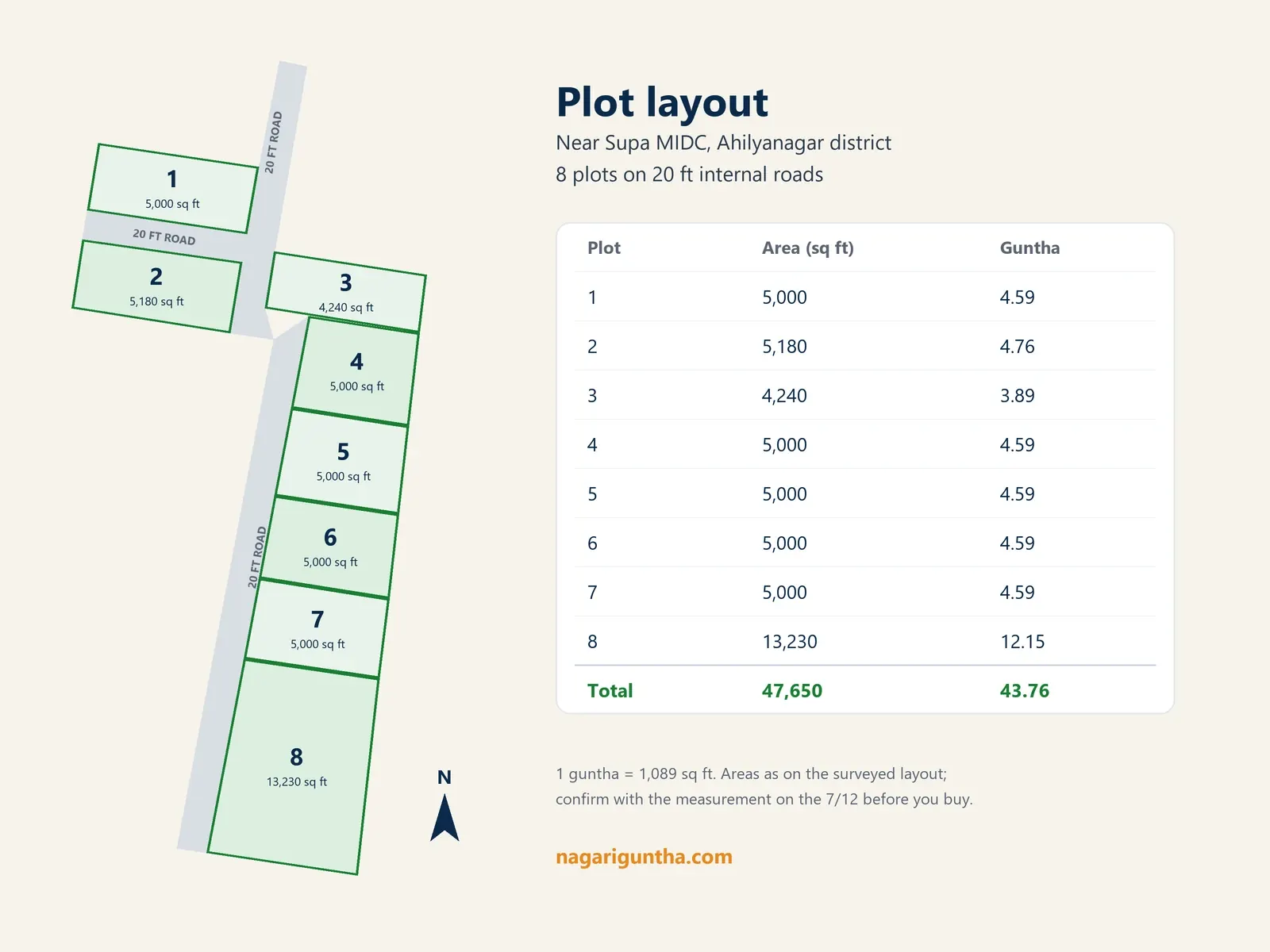
The first is about the internal roads. On the sanctioned plan they'll have a stated width. Walk them with a tape and see whether the real road matches. On the layout we're about to list near Supa MIDC, for example, the drawing shows 20 ft internal roads, and that's the kind of figure you should check on the ground and on the sanctioned plan. Then ask who owns the roads once the plots are sold. In some layouts they're handed over to the gram panchayat, while in others they stay with the developer or with the plot owners together. That decides who repairs them and who pays for street lights. Get the answer in writing.
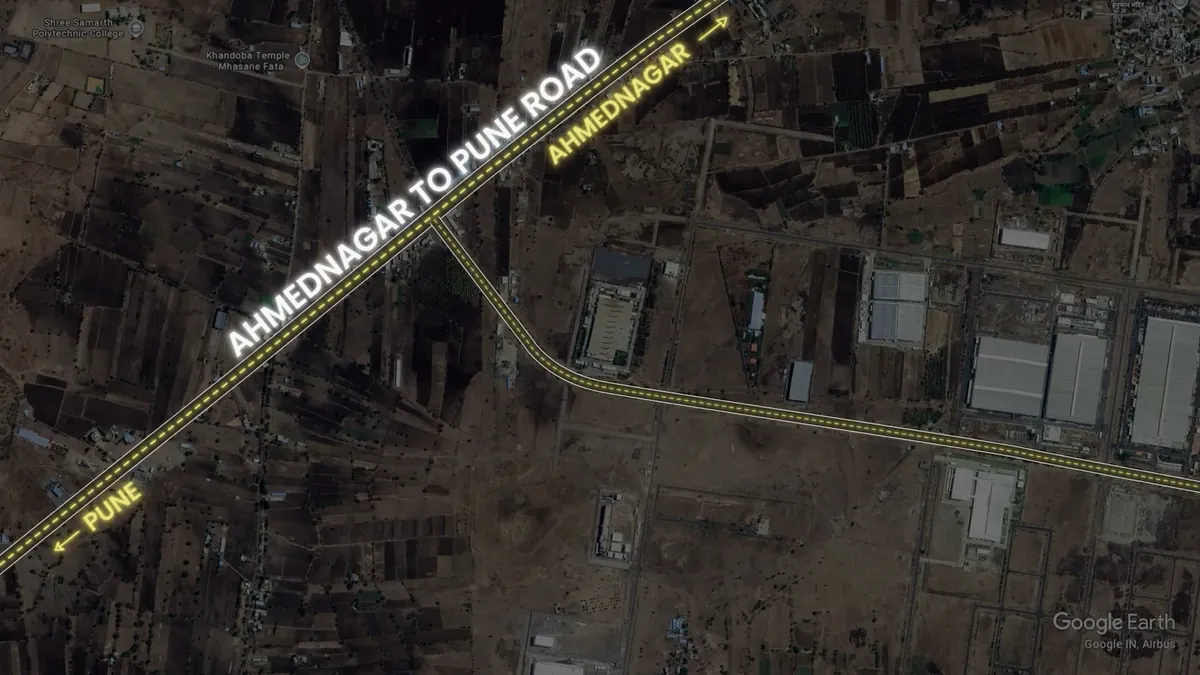
The second question is the approach road, the stretch from the nearest public road to the layout's gate. Is it a government road, a recorded farm road, or a track across someone else's field? If it crosses private land, there should be a registered right of way. Farm roads, called panand, are being mapped on the state's Mahapanand portal, which is worth a look. A layout with no legal way in is a layout you'll struggle to sell on.
Measurement by the land records office
Boundary stones put in by the developer are a start, not proof. Official measurement of land is done by the land records department (Bhumi Abhilekh), and you can apply for a measurement, called mojani, online through the state's e-Mojani site. There's a fee, and it takes time, so plan for it.
For a single plot in a sanctioned layout, ask the developer whether the whole layout was measured and demarcated by the land records office, and ask to see that measurement map. If your plot's sides on the ground don't match the plan, you want to know before the token, not when you're building a compound wall. Our posts on guntha to sq ft and reading the area on a 7/12 will help you compare numbers written in different units.
Minimum plot sizes and the fragmentation rule
Maharashtra has an old law against cutting farm land into pieces too small to farm, the Maharashtra Prevention of Fragmentation and Consolidation of Holdings Act, 1947. Under it the state fixes a "standard area" for each local area. A piece smaller than that is a fragment, and it can't be freely sold.
A December 2025 summary by the law firm Cyril Amarchand Mangaldas explains that in 2023 the state set the standard area outside corporation and council limits at about a quarter acre for irrigated land and half an acre for dry land. In gunthas, a quarter acre is 10 and half an acre is 20, since an acre is 40 gunthas. It's the reason you can't legally buy a one guntha piece of a farm and call it a plot.
The same summary describes an ordinance of 3 November 2025, later passed as an amending Act. It lifts these restrictions inside municipal limits, and on land zoned for non-agricultural use in a regional plan, among other areas. It also regularises past transfers made between 15 November 1965 and 15 October 2024 without a premium. You can read the ordinance on PRS India.
What does that mean for a plot near Supa? A small plot is legal when it's part of a properly permitted NA layout, or when it falls in one of the exempted zones. A small piece cut out of a farm in an agricultural zone and sold on a notarised paper is exactly what the law was written to stop. Which side your plot falls on depends on the zone and the papers, and that's a question for your lawyer, not for the seller.
What to write on the token receipt
If the papers look right and you decide to pay a token, pay it by bank transfer or cheque and never in cash. Get a receipt signed by the person whose name is on the 7/12, or by someone holding a registered power of attorney from them. The receipt should name the survey or gat number and the plot number on the sanctioned layout. It should also state the area, the total price and the amount you've paid.
Most of all, it should say the token is fully refundable if the title or the permissions don't pass your lawyer's check. A seller with clean papers usually won't argue with that line. If they do, it tells you something.
Before the sale deed, have a lawyer do a proper title search and go through our document checklist. Work out the stamp duty and the registration fee on the stamp duty calculator too, so the total doesn't surprise you at the sub-registrar's office.
Questions people ask
Is a gram panchayat letter enough for a plot?
We wouldn't rely on it alone. A letter from the gram panchayat doesn't replace NA permission or a sanctioned layout. Ask your lawyer what this layout needs.
The seller says NA is "in process". Should I pay?
We'd wait. Until the permission is granted and recorded, you're paying for a plot that doesn't legally exist yet.
Can an NRI buy a plot in a layout like this?
Under RBI rules an NRI can generally buy residential property in India but not agricultural land or a farmhouse. Our NRI page explains more, and your lawyer should confirm it for your own case.
How long does all this take?
Downloading the 7/12, the 8A and the ferfars takes an evening if the websites behave. A lawyer's title search and a government measurement take longer, so start early.
Your next step
Ask the seller for the 7/12 and the NA permission today, along with the sanctioned layout plan and the measurement map. If they're slow to share any of them, that's your answer. If they share everything, send it to us on WhatsApp and we'll go through it with you, with zero brokerage for buyers.
Written by the Nagari Guntha team in Ahilyanagar: a DPIIT-recognised property company with zero brokerage for buyers. We write about what buyers and owners ask us every day. About us