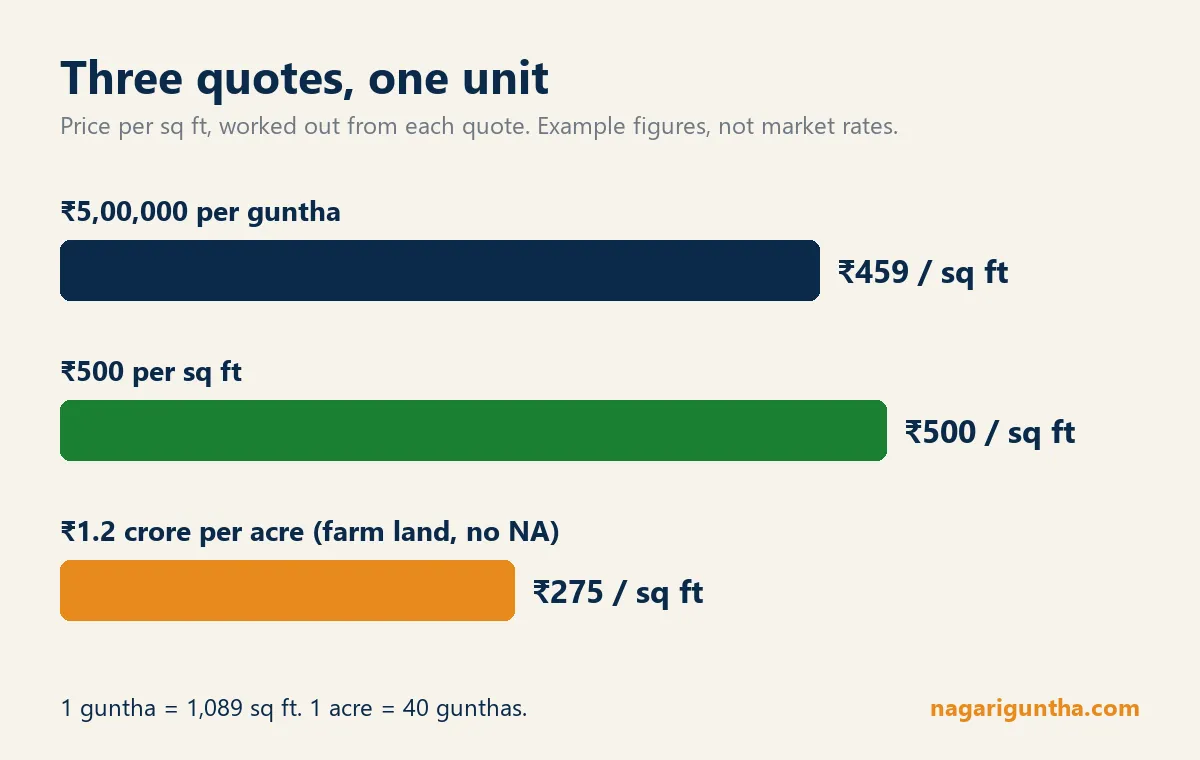
On a single Sunday of plot visits outside Ahilyanagar you can easily hear three prices in three different units. The first layout is "5 lakh a guntha". The second is "₹500 a square foot", and a farmer down the road wants "1 crore 20 lakh an acre" for a piece of his land. They sound like they're in the same range, but you can't really tell until you turn them into one unit.
This post does that with real arithmetic. The prices in the examples are round numbers we've picked to make the sums easy to follow, and they aren't market rates for any area. Swap in the figures you're being quoted.
The numbers to remember
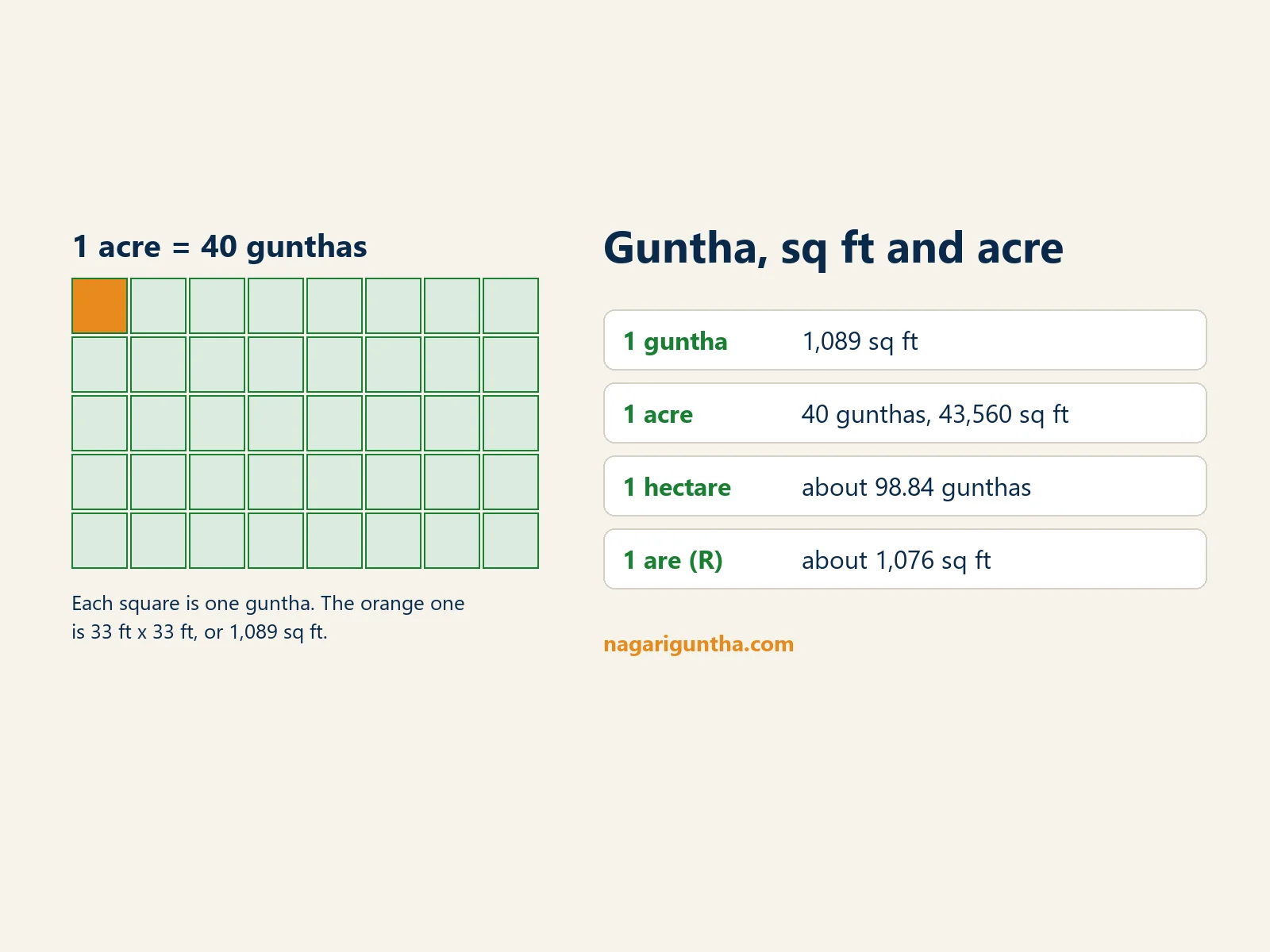
One guntha is 1,089 sq ft, a square of 33 ft by 33 ft. Forty gunthas make an acre, which is 43,560 sq ft. A hectare, which is how the 7/12 writes area, is 10,000 sq m. That's about 1,07,639 sq ft, which works out to about 98.84 gunthas.
Put any area into the converter below and it'll give you the rest.
Land area converter
- Gunthas
- Acres
- Hectares
- Ares (R)
- Sq.ft
- Sq.m
- Sq.yards
Exact unit conversions (1 guntha = 1,089 sq.ft, 40 gunthas = 1 acre). For a legal measurement, ask the land records office to survey the plot. Open the full calculator
Turning a per guntha price into per sq ft
Divide the price per guntha by 1,089. That's the whole trick, and people skip it all the time.
Take the first layout at ₹5,00,000 a guntha. Divide by 1,089 and you get about ₹459 a sq ft. The second layout, at ₹500 a sq ft, works out to ₹5,44,500 a guntha when you multiply back by 1,089. They sounded similar. The second one is actually ₹44,500 more per guntha, close to 9% dearer, before you've looked at anything else.
Now the farmer's acre. ₹1.2 crore divided by 40 is ₹3,00,000 a guntha, and divided again by 1,089 it's about ₹275 a sq ft. That looks much cheaper, and in a sense it is. But an acre of farm land isn't a plot. It has no NA permission and no sanctioned layout yet, and part of it will go to roads if it's ever divided. We'll come back to that below.
A worked example for a whole plot
Say a layout offers a 2.5 guntha plot at ₹4,80,000 a guntha. The price is 2.5 times 4,80,000, which is ₹12,00,000. The area in square feet is 2.5 times 1,089, or 2,722.5 sq ft. Divide the price by the area and you get about ₹441 a sq ft.
Compare that with a 1,500 sq ft plot in another layout at ₹450 a sq ft, which costs ₹6,75,000. In gunthas, 1,500 sq ft is about 1.38. That puts the price at about ₹4,90,000 a guntha. The second plot is smaller and a little dearer for each unit of land, even though ₹450 sounds close to ₹441.
None of this tells you which plot is better. A corner plot or a wider road changes what a plot's worth, and so does how far it is from the layout's gate. The arithmetic just makes sure you're comparing prices, not units.
A real layout, in both units
It helps to see this on an actual drawing. This one is the plotted layout near Supa MIDC that we're about to list. Plot 1 is 5,000 sq ft, which the table shows as 4.59 gunthas, because 5,000 divided by 1,089 is 4.59. Plot 8, the biggest, is 13,230 sq ft or 12.15 gunthas, and the whole layout's plots add up to 47,650 sq ft, about 43.76 gunthas.
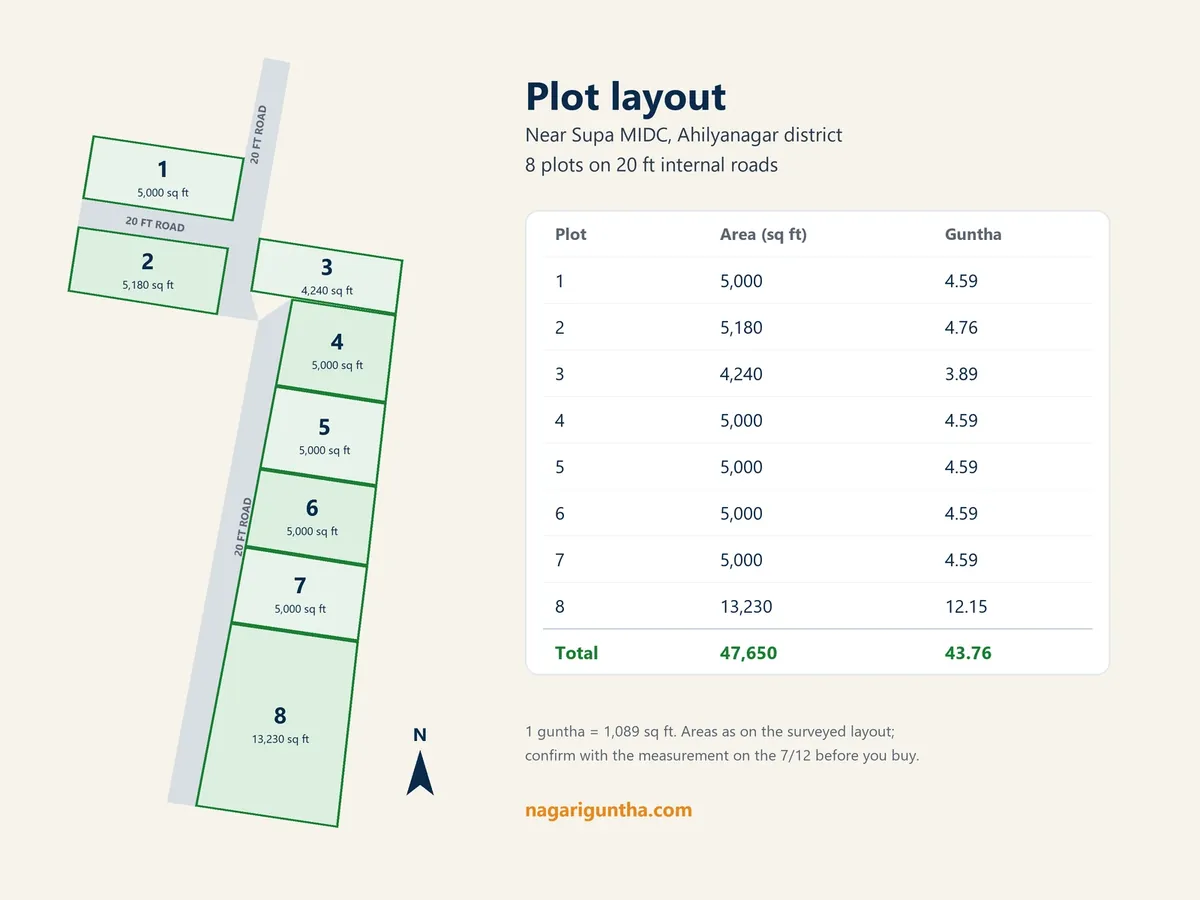
We aren't putting prices on this page, because the owner sets the price of each listing and it can change. When the layout goes live, it'll be on our listings with zero brokerage for buyers. Take whatever price you're quoted and run it through the same sums.
Why the layout area isn't the 7/12 area
This catches a lot of buyers. The 7/12 shows the area of the whole survey or gat number, written in hectares, ares and square metres (our 7/12 area post explains the format). A layout plan shows each plot. Add up all the plots and you won't get the 7/12 figure, and there's nothing suspicious about that on its own.
The gap is the land that isn't sold as plots. Internal roads take a share, and so do the open space and any amenity plot the rules require. Some land may be marked pot kharab on the 7/12, which means it can't be cultivated. There can also be small differences between an old record and a fresh measurement.
That gap matters when you compare a layout plot with raw land. Take a field shown on the 7/12 as 1.00.00, which is one hectare, or about 98.84 gunthas. Suppose, purely as an example, that roads and open space take a quarter of it. That leaves about 74 gunthas to sell as plots. If the owner paid ₹3,00,000 a guntha for the whole hectare, the land under each guntha of saleable plot has actually cost about ₹4,00,000, and that's before anything is spent on roads or the electricity line. It's one reason a layout plot costs more per guntha than the farm next door.
Ask the seller to state the area of your plot in the sale deed in both sq ft and sq m, and check that it matches the sanctioned layout. Our posts on reading the area on a 7/12 and guntha to sq ft have more examples.
What you'll pay on top of the price
The quoted price isn't what leaves your bank account. The biggest extra is stamp duty, and after that the registration fee. Both are paid when the sale deed is registered at the sub-registrar's office.
The rates below are the ones on our stamp duty calculator, which we checked against IGR Maharashtra's published Stamp Act and fee table in October 2026. Inside a municipal corporation or a council area, it's 5% stamp duty plus a 1% local body surcharge, which makes 6% in all. In a gram panchayat area it's 4% stamp duty. We couldn't confirm whether the 1% surcharge applies there, so ask the sub-registrar's office. The registration fee is 1% of the value, up to a maximum of ₹30,000.
Duty is charged on the market value, and the office will look at the government's ready reckoner rate for the area. That can make the figure it uses higher than the price you agreed, so ask which value they'll use before you budget.
Back to the 2.5 guntha plot at ₹12,00,000. If it's in a gram panchayat area, stamp duty at 4% is ₹48,000 and the registration fee is ₹12,000, so you'd pay ₹60,000 on top, plus any surcharge the office says applies. If the same plot were inside a council area, 6% would be ₹72,000. Add the same ₹12,000 fee and it comes to ₹84,000.
Stamp duty and registration
in all
Stamp duty · Local body surcharge · Registration
A first estimate. Rates and charges change; confirm with your bank or the IGR Maharashtra website. Open the full calculator
Then there are costs that don't come with a fixed rate. Your lawyer will charge for the title search. A government measurement has its own fee if you want one, and some layouts charge for development or maintenance. If the plot has no electricity yet, an MSEDCL connection and a compound wall come later too. Ask the seller to list every charge in writing, with the amount.
Working back from your budget
Most families don't start with a plot. They start with a number they can spend, and it helps to run the sums backwards. Say you have ₹10,00,000 in all, and the plot is in a gram panchayat area. Stamp duty at 4% and a registration fee of about 1% add roughly 5% to the price, so the most you can pay for the plot itself is about ₹9,52,000. At ₹450 a sq ft, that buys about 2,116 sq ft, which is a little under 2 gunthas.
That figure still leaves out the lawyer, the measurement and the electricity connection, so in real life you'd aim a bit lower. If you're taking a loan, open the affordability calculator first and work out the budget before you look at plots at all.
Small differences in area cost real money
A tenth of a guntha sounds like nothing. It's 108.9 sq ft, and at ₹450 a sq ft that's ₹49,005. If a seller says a plot is "about 2.5 gunthas" and the measurement comes out at 2.4, you'd be paying close to ₹49,000 for land you aren't getting. Ask for the exact area in sq ft or sq m on the sale deed, and pay for that area, not for a round number someone said on the phone.
The same goes for corner cuts. A plot that's 50 ft by 60 ft on the drawing but loses a triangle at one corner to a road splay isn't 3,000 sq ft. It's less. The sanctioned plan and the measurement map will show the true shape, and the price should follow it.
A few traps with units
Some sellers quote per "R", which on a 7/12 is an are, or 100 sq m. That's about 1,076 sq ft, close to a guntha but not the same, and the difference adds up on a big piece. Others quote per square yard, which is 9 sq ft, especially if they've worked in other states. A brochure that shows the plot in sq m while the price is per sq ft will make you do the conversion twice. Write every quote down with its unit, then convert.
If you're buying from abroad, our NRI page shows the price and these costs in your own currency.
Questions people ask
Is a guntha the same everywhere in Maharashtra?
Yes, it's 1,089 sq ft. Other states use their own local units, so don't carry a figure across a state border without checking.
Should I compare plots per sq ft or per guntha?
Either works, as long as you use the same one for every plot. Most people around Ahilyanagar find per sq ft easier to picture.
How do I turn square metres into square feet?
Multiply by about 10.764. A 200 sq m plot is about 2,153 sq ft, which is just under 2 gunthas. The converter above does it for you if you pick sq m.
What's a fair price per guntha near Supa MIDC?
We don't publish one, because it changes from road to road and from layout to layout. Compare at least three plots in the same unit, look at what each one has in the way of papers and roads, and then decide.
Does the woman buyer's stamp duty concession apply to plots?
The note we found in the printed Stamp Act refers to a residential unit, so for a plot ask the sub-registrar's office before you count on it.
Are the prices in this post real?
No. They're round figures to show the sums. Ask for the current price of a real plot on our listings.
Your next step
Write down every plot you've been quoted this month with its unit, and turn each one into a price per sq ft using the converter above. Then add stamp duty and the registration fee on the calculator. Before you pay anything at all, go through our document checklist.
Written by the Nagari Guntha team in Ahilyanagar: a DPIIT-recognised property company with zero brokerage for buyers. We write about what buyers and owners ask us every day. About us